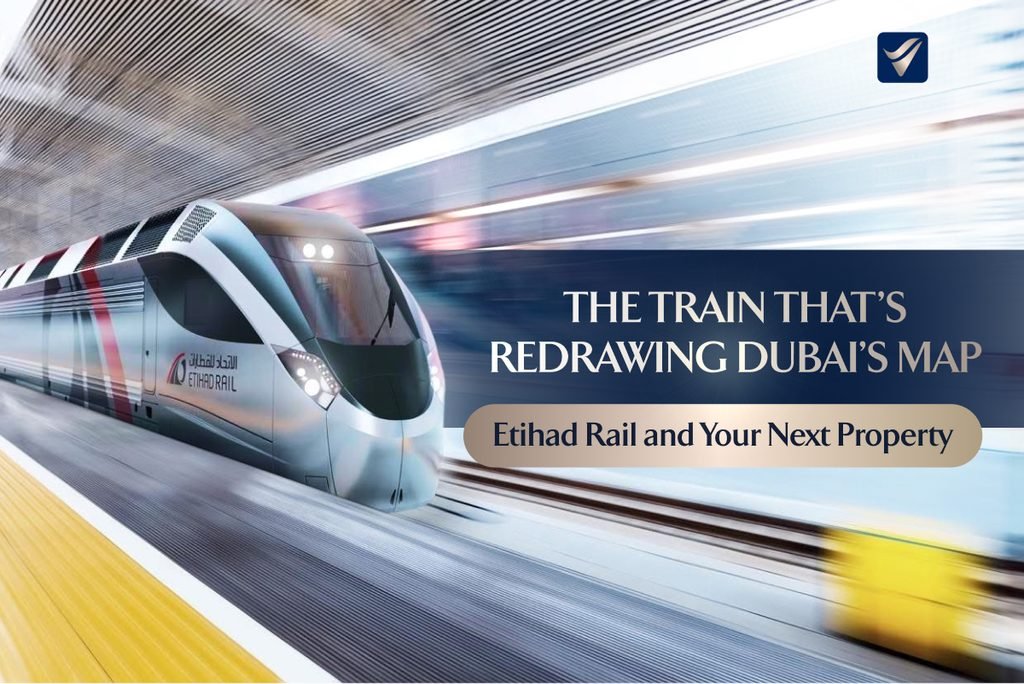
At 6:14 am on 30 September 2026, the first Etihad Rail train pulled out of Dubai’s new Al Yalayis Station, bound for Abu Dhabi. For the first time, you can travel between the two emirates by passenger train, and if you’re thinking about buying property in Dubai in 2026, that changes the map you’re working with.
So what is this famous project, how much of it is actually built, and what does Etihad Rail really mean for rents, prices and where you might choose to live or invest? Let’s walk through it properly: the story first, then the property angle.
What Is Etihad Rail? The UAE’s National Railway at a Glance
Most people first heard about Etihad Rail as “the train that’s coming.” In reality, it has been quietly running for years, just not with passengers.
The project in brief
Etihad Rail is the UAE’s national railway, built to move both goods and people across the country. It sits at the heart of a national rail programme backed by an investment of roughly AED 50 billion, and Etihad Rail estimates the programme could generate around AED 200 billion in economic benefits over the next 50 years. Those are the company’s own projections, but they explain why the project is treated as a long-term national priority rather than just a transport upgrade.
The existing network already links major ports and industrial zones, including Khalifa Port, Jebel Ali and the Port of Fujairah. The passenger side adds something new: a service that will eventually connect 11 cities and regions across all seven emirates, with trains that carry up to 400 passengers at speeds of up to 200 km/h.
How it got here: a quick timeline
The project has been built in stages, and the story is a lot longer than this year’s headlines suggest.
| Year | Milestone |
| 2009 | Etihad Rail is founded |
| 2016 | Stage One, a 264 km freight line, begins commercial operations |
| 2018 | Construction on Stage Two is launched |
| 2023 | Stage Two opens, taking the operating network to around 900 km |
| 2026 | Passenger service begins: Abu Dhabi to Fujairah on 30 June, then Dubai and Al Dhaid on 30 September |
So when people say Etihad Rail “just launched,” what they really mean is that the passenger chapter has begun on infrastructure that has been growing for well over a decade.
Where the passenger line runs
The passenger network stretches from Al Sila, near the Saudi border in the west, through Abu Dhabi and Dubai, up to Al Dhaid in Sharjah, and across to Fujairah on the east coast. If you want a visual, think of a long spine running through the country, with stations that will gradually switch on over the coming months.
Etihad Rail Dubai Is Now Live
The Dubai launch didn’t happen quietly. The station was inaugurated on 28 September, with the UAE President travelling by train from Abu Dhabi, and public service began two days later.
Launch week at a glance
On day one, there were ten daily Abu Dhabi–Dubai trains, five in each direction. Demand showed up almost immediately: Etihad Rail added six extra weekend services, with more than 2,000 additional tickets, after what it described as exceptional early demand.
The Abu Dhabi–Fujairah route, which started in June, had already carried more than 150,000 passengers by the time Dubai came online.
Here are the details most people ask about:
| Detail | What to know |
| Dubai station | Al Yalayis Station, in Jumeirah Golf Estates |
| Abu Dhabi station | Mohamed bin Zayed City |
| Journey time | About an hour (early estimates said 57 minutes; the live schedule is around 1 hour 4 minutes) |
| Fares | AED 39 (Comfort) and AED 109 (Premium) |
| Frequency at launch | 10 trains a day, five each way, plus extra weekend services |
| Payment and ticketing | One Nol QR code works across train, Metro, Tram and bus |
Al Yalayis Station: why the location matters
Here’s the detail property buyers should notice. Al Yalayis isn’t in the heart of downtown Dubai. It sits in Jumeirah Golf Estates, and a 400-metre elevated walkway connects it to the Metro Red Line. That means passengers can step off an intercity train and carry on across Dubai on the Metro, using the same Nol ticket.
It’s a smart piece of design, and it explains why so many people are suddenly asking which communities benefit. We’ll get to that shortly.
When Will Etihad Rail Be Complete? What’s Open and What’s Coming
The honest answer is that Etihad Rail is rolling out in phases, not all at once. Here’s what’s confirmed and what’s still ahead:
| When | What happens |
| Open now | Abu Dhabi, Dubai, Fujairah and Al Dhaid |
| 30 November 2026 | Liwa and Madinat Zayed stations open |
| 30 December 2026 | Al Dhafra stations open |
| 30 March 2027 | Sharjah Station opens |
| 2031 (targeted) | Abu Dhabi–Dubai high-speed rail |
| September 2032 | Dubai Metro Gold Line, which also serves Jumeirah Golf Estates |
| No confirmed date | Hafeet Rail to Oman and the wider GCC network |
If you were looking for a single “Etihad Rail completion date,” there isn’t one.
The passenger network is being switched on station by station through 2027, and the bigger projects run well into the next decade.
Beyond the Current Line: High-Speed Rail, Hafeet Rail and the GCC
Here’s where the story gets bigger than a single train line.
The Abu Dhabi–Dubai high-speed line
Today’s journey takes about an hour, but that’s just the beginning. Construction has started on a separate 150 km high-speed line between Abu Dhabi and Dubai, designed to cut the trip to around 30 minutes, with trains running at up to 320 km/h. The contractor’s target is 2031, a year later than the previously reported 2030 date, so it’s worth treating that date as a target rather than a promise.
The planned stations include Al Zahiyah, Saadiyat Island, Yas Island and Abu Dhabi Airport on the Abu Dhabi side, and Al Jaddaf in Dubai. If you follow property trends, you’ll notice that it is a very different part of Dubai from Jumeirah Golf Estates, and it adds a second story to watch over the longer term.
Hafeet Rail and the GCC vision
Further out, the 238 km Hafeet Rail project will link the UAE to Oman, with a journey from Abu Dhabi to Sohar of around 100 minutes.
Beyond that sits the long-term ambition of a wider GCC rail network. Etihad Rail’s CEO has suggested that, once such a network exists, Abu Dhabi to Riyadh could take under five hours by train. That’s a vision, not a schedule, but it shows how the UAE sees this project: as a regional backbone, not just a commuter line.
How Does Rail Actually Influence Property?
Before we look at specific communities, it helps to understand how a railway affects a property market, because it’s more subtle than “train arrives, prices jump.”
It changes how distance feels.
People don’t think in kilometres; they think in door-to-door time. A trip that was 90-plus minutes by car in traffic and is now about an hour by train, with a Metro link at the end, makes a different commute realistic.
It widens the catchment.
Jobs, schools, healthcare and leisure in another emirate become more accessible, which can broaden the pool of people willing to live in a connected area.
It tends to show up in rents before prices.
More on this in a moment, but the first reaction in most markets is tenant interest, not headline sale prices.
It depends on the last mile.
A station is only as useful as the way you reach it and leave it. Abu Dhabi’s stations sit outside the city centre, which is why shuttle services run to places like the Corniche, Reem Mall and ADNEC. Dubai’s Metro link at Al Yalayis plays the same role.
It can be priced in early.
Markets often react to announcements years before a station opens, so by the time a train actually runs, part of the benefit may already be reflected.
Keep these five ideas in mind. They explain almost everything that follows.
What Etihad Rail Dubai Could Mean for the Property Market
Buyers and renters keep asking this question, so let’s give it the careful answer it deserves.
The first signals: rents before prices
Market experts expect the earliest effects to show up in enquiries, viewings, and rents, rather than an immediate rise in sale prices. That’s a sensible way to think about it.
If a commuter from Abu Dhabi decides to rent in Dubai, or the other way round, the rental market feels it first. Sales values, if they move, tend to follow more slowly.
If you want to track this yourself, watch for rental enquiries in connected areas, Dubai Land Department transaction activity, and how long listings stay on the market.
A community watchlist
No single list captures everything, but here’s a practical way to think about the areas people are talking about. Note that most of these connect to the station by road, not on foot.
| Community | Connection to the rail story | What to watch |
| Jumeirah Golf Estates | Home to Al Yalayis Station, with a walkway to the Metro | Premium villa interest and resale liquidity |
| Al Furjan, Dubai Investment Park, Green Community, Dubai Production City | Within road reach of the station | Interest from commuters travelling to or from Abu Dhabi |
| Expo City, Dubai South | Road access, with plenty of newer supply | Comparing new projects against established areas |
| Al Jaddaf | Planned high-speed rail station in Dubai | A longer-term story linked to the 2031 target |
Jumeirah Golf Estates: where experts disagree
It’s tempting to assume that the community with the station is the obvious winner, but the experts don’t fully agree, and that’s worth knowing.
Some suggest that part of the connectivity benefit may already be priced in, but still expect the station to support liquidity and value over the long term. On the other hand, some experts take a more cautious view, saying it doesn’t anticipate a significant direct impact on prices within Jumeirah Golf Estates itself.
Both can be true at once. A well-connected community can become more liquid and more attractive to tenants without seeing a dramatic price jump. For you as a buyer, the useful takeaway is simple: don’t treat a station as a guarantee. Treat it as one positive factor among many.
Who benefits most?
Different readers will feel this differently:
- Commuters and tenants. If you live in one emirate and work in the other, the new service widens your options. Tenants are often the first to respond to a change like this.
- Investors and landlords. Connected pockets may see steadier tenant interest, though yields still depend on the building, the price you paid and your service charges.
- Off-plan buyers. New launches near the corridor will naturally highlight rail access, so compare them carefully against established alternatives. Our guide to off-plan vs ready property in Dubai can help you weigh that decision.
- End users. If you simply want easier weekend travel across the UAE, you may value the convenience even if the investment case is modest.
The Abu Dhabi end of the line
The story isn’t one-directional. The Abu Dhabi station in Mohamed bin Zayed City anchors a growing commuter catchment, and the planned high-speed line will add stations on Saadiyat Island, Yas Island and at the airport.
Some Dubai residents may find Abu Dhabi more accessible than ever, and some Abu Dhabi residents may start considering Dubai. For buyers, it’s a reminder that rail can widen the choices on both sides.
Sharjah, Al Dhaid and the Northern Emirates
With Al Dhaid already open and Sharjah Station due on 30 March 2027, the northern part of the network is expected to draw more attention as it matures. Areas with more space and a different lifestyle may become more practical for people who previously ruled them out because of the commute. That said, the benefits won’t be evenly spread, and the best-connected stations will matter more than the map alone suggests.
The Long View: Rail, Metro and High-Speed Rail as Layers
Rather than one big event, think of this as three layers arriving over time.
- Now: the conventional Etihad Rail line, with Al Yalayis linked to the Metro Red Line.
- Around 2031: the high-speed Abu Dhabi–Dubai line, with a Dubai station at Al Jaddaf.
- September 2032: the Dubai Metro Gold Line, which will also serve Jumeirah Golf Estates.
Each layer strengthens the one before it. It’s one reason many analysts talk about connectivity as a long-term theme rather than a short-term trade, and it’s why patience tends to matter more than timing here.
What Etihad Rail Doesn’t Guarantee
A good guide should be honest about the limits, so here they are.
It doesn’t guarantee price growth. Rail improves access, but supply, demand, interest rates, and the wider market still drive values.
It doesn’t guarantee rental yields. Better access can support tenant demand, but your actual return depends on what you pay, what you charge, and your service charges.
It doesn’t make every nearby property a good buy. Developer quality, building age, community maturity and future supply all matter as much as a station on the map.
Early expectations can run ahead of reality. If a community is already being marketed heavily on rail access, ask how much of that benefit is already reflected in what you’re being asked to pay.
How to Evaluate a Property Near Etihad Rail
If you’re considering buying in a connected area, here’s a practical checklist you can use:
- Confirm the dates. Station openings are phased, so check which stations are actually open and which are still planned.
- Test the journey. Work out your real door-to-door time, including the first and last mile, not just the time on the train.
- Check last-mile links. Is there a Metro connection, a shuttle or a realistic driving route to the station?
- Review future supply. Are many similar units about to launch nearby? That can affect both rents and resale.
- Vet the developer. Track record matters, especially for off-plan projects.
- Look at the full cost of owning. Service charges and transaction costs affect your return. Our guide to the costs of buying property in Dubai breaks these down.
- Think long term. The strongest case for connectivity builds over years, not weeks.
Final Thoughts
Etihad Rail is one of the UAE’s biggest infrastructure stories, and Dubai is now part of it. For buyers, the useful way to see it is as a long-term improvement in how the country connects, not a shortcut to quick returns. It can make certain locations more convenient, more liquid and more appealing to tenants, but it doesn’t replace the fundamentals: the right community, the right developer, the right price and the right plan for your goals.
If you’re weighing up where to buy in Dubai in 2027, the smartest move is to match your choice of community to how you actually plan to live or invest, and let connectivity be one factor in that decision rather than the only one.
Thinking About Buying Near the New Rail Line?
Whether you’re considering a home in Jumeirah Golf Estates, a rental investment in a connected community, or a new launch along the corridor, you don’t have to work it out alone. Speak with our property advisors to compare communities, review payment plans and understand the full cost of ownership, so you can choose with confidence.
Book your free consultation today.
Disclaimer: This article is for general information only and isn’t investment advice. Timelines, fares and schedules are based on information available at the time of writing and may change, so please confirm current details with Etihad Rail and the relevant authorities. Property values and rents can rise or fall, and a nearby station doesn’t guarantee any particular outcome.